Trusted Local Partners
Every car rental company on goArid is a Namibian provider. Your money stays in Namibia, supporting the local tourism economy and local communities.
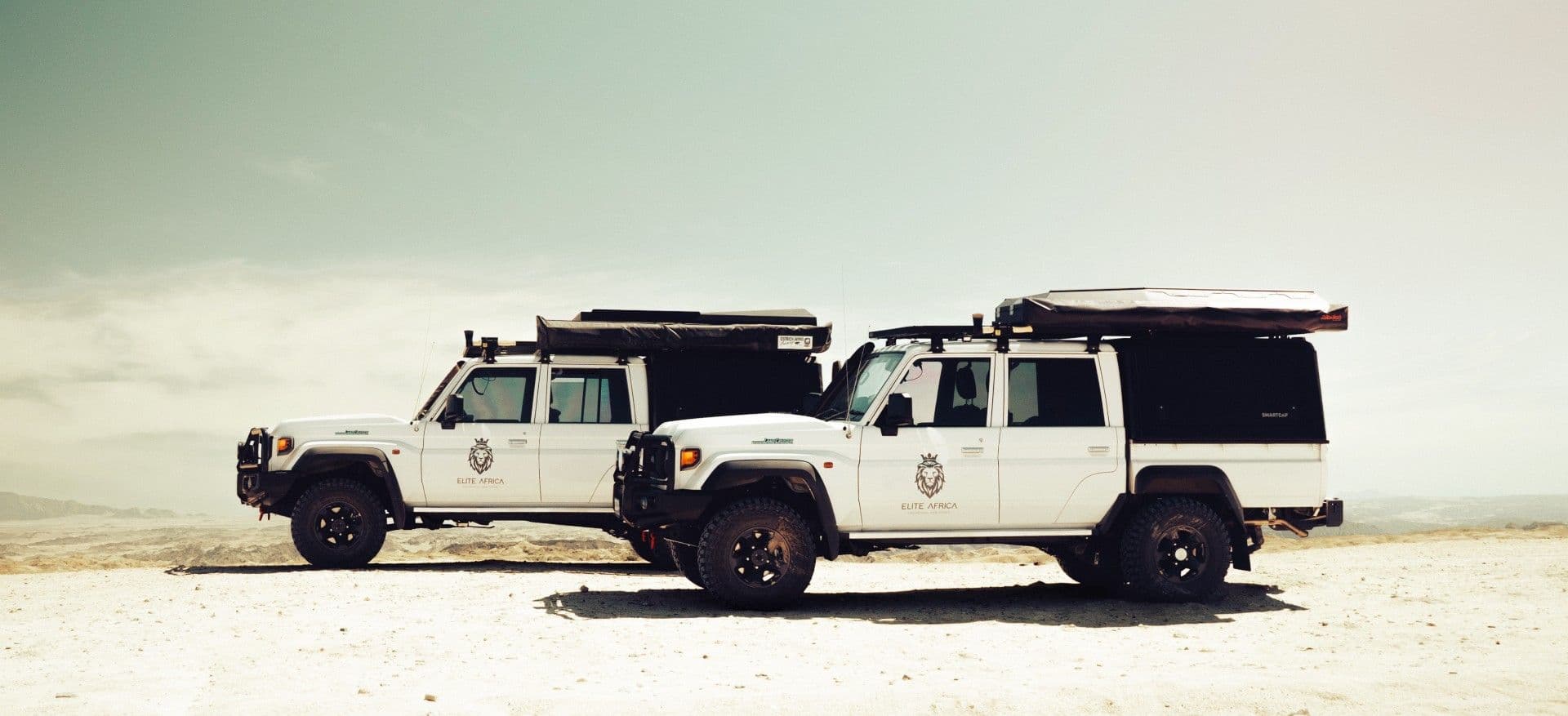
Robust. Reliable. Unstoppable – built for off-road adventures in Namibia.

Rent a Land Cruiser or Hilux in Namibia? Compare models & equipment from multiple suppliers. ✓ Camping for up to 6 people
Namibia is one of the few countries where a 4x4 vehicle isn't just an option — it's often the prerequisite for a safe and relaxed trip. While classic routes like Etosha, Sossusvlei, or Swakopmund can generally be handled well with a standard 4x4 rental, routes into the Kaokoveld, Damaraland, or along the Skeleton Coast belong to an entirely different category of terrain.
This is exactly where the Toyota Land Cruiser comes in. Among self-drive travelers and rental companies alike, it's considered the benchmark vehicle for Namibia's most demanding routes — robust, powerful, and reliable.
Every car rental company on goArid is a Namibian provider. Your money stays in Namibia, supporting the local tourism economy and local communities.
You send a request — we check availability and send you a clear quote that also shows any required deposit and possible cancellation fees. No obligation, fully transparent, and no commitment.
Different local car rental companies at a glance — compare equipment, prices, and terms side by side. Save time and let us do the work. We know the differences between the rental companies and which vehicle best suits your trip.
From your first request to the end of your trip — personal and free of charge. No hidden extra costs — with goArid, you always reach a real person, backed by first-class service from an experienced team before and during your trip.
Not every Namibia route requires a Toyota Land Cruiser. Here's when it's worth upgrading from the Hilux.
Deep sand stretches
Routes through the Kaokoveld, the Marienfluss Valley, and parts of the Skeleton Coast run for kilometres through soft sand, where differential locks and low-range gearing are essential.
Remote regions without infrastructure
Areas like Damaraland, the Kunene Region, and the Messum Crater are located many kilometres from the nearest fuel station or mobile signal. A rugged build and reliable power are essential here.
River crossings
Seasonal riverbeds in the north require vehicles capable of handling uneven, rocky terrain and light water crossings during the rainy season.
Rocky terrain
On rocky terrain, the Land Cruiser's high ground clearance and rugged off-road equipment ensure the vehicle doesn't scrape the underside and reliably absorbs impacts.
At goArid, two Land Cruiser variants are currently available through our partners, differing significantly in build and seating capacity:

Which variant is right for you depends on your travel style: larger families or groups benefit from the space and comfort of the HJ 76, while the HJ 79 is the more compact, off-road-focused camping solution for smaller groups.
Both Land Cruiser models come standard with a rugged off-road foundation:
Ground clearance: The Land Cruiser offers significantly more ground clearance than classic pickup models, allowing it to handle loose rocks, deep ruts, and steep climbs with ease.
Differential locks: Front and rear differential locks are standard on both Land Cruiser models, ensuring reliable traction even in loose sand or on slippery surfaces.
4x4 system: Permanent four-wheel drive with low-range gearing provides dependable traction on any terrain, from gravel to sand.
Engine, transmission, and tank size can vary noticeably between providers and individual vehicles — even within the same model designation. The figures below show the typical range:
Land Cruiser HJ 76
Land Cruiser HJ 79
Since engine and transmission vary by provider and individual vehicle, it's worth checking the specific vehicle description of the respective provider before booking.
Anyone considering a Toyota Land Cruiser will almost always compare it to the more affordable Toyota Hilux. The Land Cruiser comes with a noticeably more powerful engine (2.8L, 4.0L, or 4.5L), while the Hilux typically runs on 2.4 or 2.8 litres. The Hilux also falls short on space: while it usually seats 4 to 5 people, the Land Cruiser HJ 76, for example, can seat up to 8 without camping equipment.

When it comes to off-road equipment, some providers fit the Land Cruiser with additional extras like a hi-lift jack, an external diesel canister, or more rugged bumpers and side steps — features that are less commonly standard on the Hilux.
That said, one point clearly speaks in favour of the Hilux: it, too, handles the vast majority of routes in Namibia without any issues. Most classic travel routes, such as Etosha, Sossusvlei, or the main tracks through Damaraland, are easily manageable with a Hilux as well. The decision, then, should be based less on vehicle size alone and more on the planned route: it's only once you head into particularly demanding areas like the Kaokoveld or remote riverbeds that the Land Cruiser's added value truly pays off.
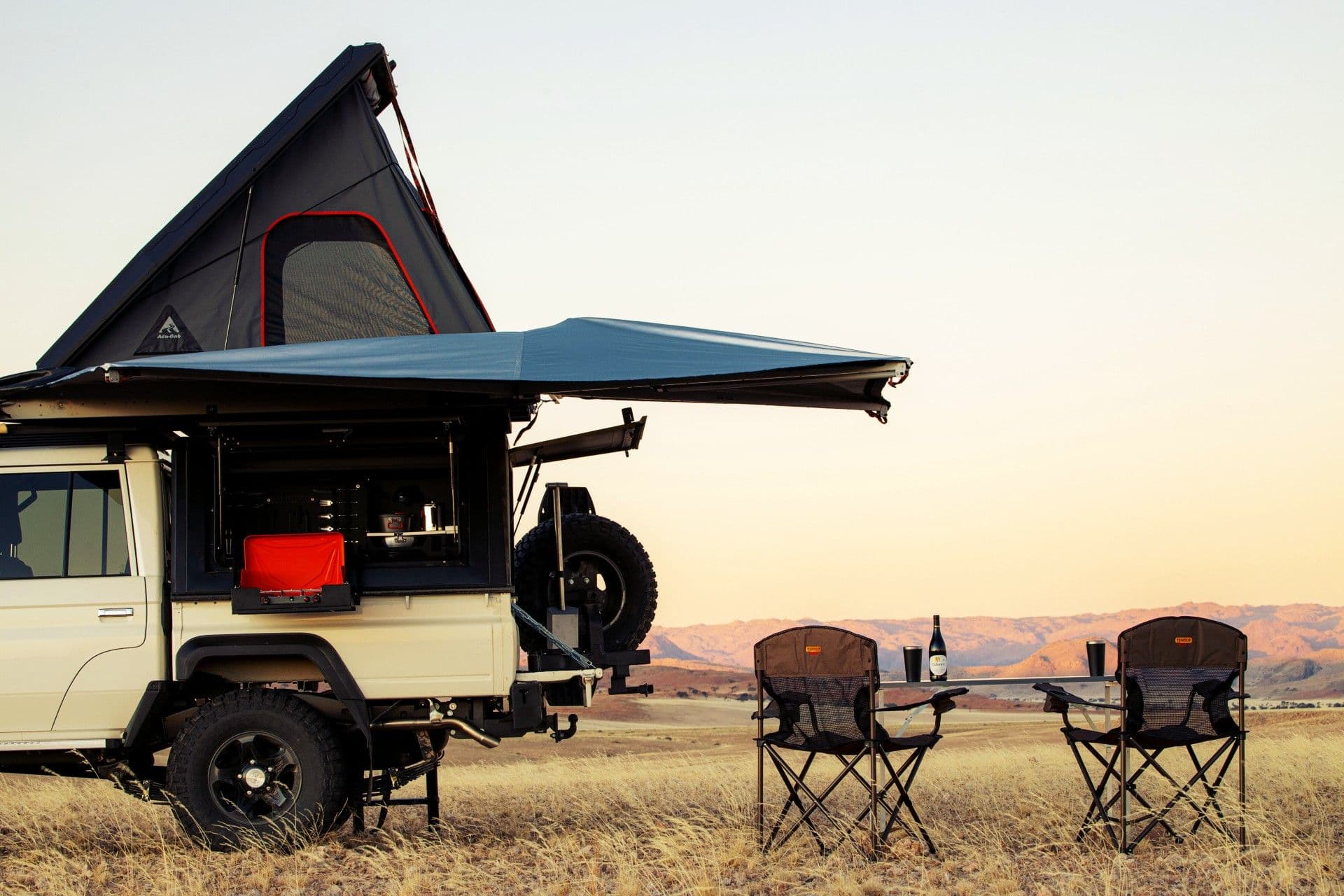
Equipment can vary significantly between the different providers listing a Land Cruiser on goArid. Some vehicles come fully equipped for an expedition right away, including a rooftop tent, cool box, cooking gear, and off-road accessories like a compressor or sand tracks. With other providers, the base vehicle is kept fairly minimal, and camping equipment needs to be booked separately.
When making your decision, it's therefore less useful to look at a general list of features and far more important to compare providers directly: what's already included in the rental price, and what costs extra? Especially when it comes to rooftop tents, cool boxes, and off-road gear, the actual total cost can differ noticeably between two seemingly similar Land Cruiser offers.

The Land Cruiser opens up regions that aren't safely accessible with a standard 4x4: the Kaokoveld, the riverbeds of Damaraland, parts of the Marienfluss region, and remote stretches along the Skeleton Coast. For these areas, the Land Cruiser is generally considered the industry-standard minimum requirement.
That said, it's important to set the right expectations: even a Land Cruiser isn't a free pass for every route.
Some of Namibia's most difficult passages are contractually excluded by virtually all rental providers, regardless of vehicle type. The best-known example is Van Zyl's Pass in the far northwest: due to its extreme gradient, loose rock, and the fact that it can only be driven in one direction, it's considered one of the most dangerous routes in the country. Many rental agreements exclude it entirely for this reason, no matter which vehicle is booked, and instead recommend travelling with a local guide or joining a guided tour.

For travellers, this means route planning shouldn't just ask whether a vehicle is technically capable, but also whether the specific provider even permits the planned route. This information varies from provider to provider and is worth comparing carefully before booking.
In addition to the vehicle and its equipment, there are a few organisational points worth keeping in mind when booking a Toyota Land Cruiser in Namibia:
Important notice: The Land Cruiser HJ 76 is often fully booked a year in advance during peak season (July to September) — we recommend booking as early as possible.

The Toyota Land Cruiser remains the safest choice for anyone travelling with a larger group or family who wants maximum reserves in engine power, tank size, and off-road equipment on Namibia's most demanding routes. The HJ 76 stands out for its space and comfort, while the HJ 79 offers a more compact, classic camping setup.
For those travelling as a couple or in a smaller group and sticking to Namibia's classic travel routes, the more affordable Toyota Hilux will often get you there just as well — provided the planned route doesn't specifically require a Land Cruiser, whether due to a particular provider's contractual restrictions or especially demanding sections of the route.
Either way, the details vary from provider to provider — it's always worth taking a close look at equipment, insurance, and route permissions before booking.


